
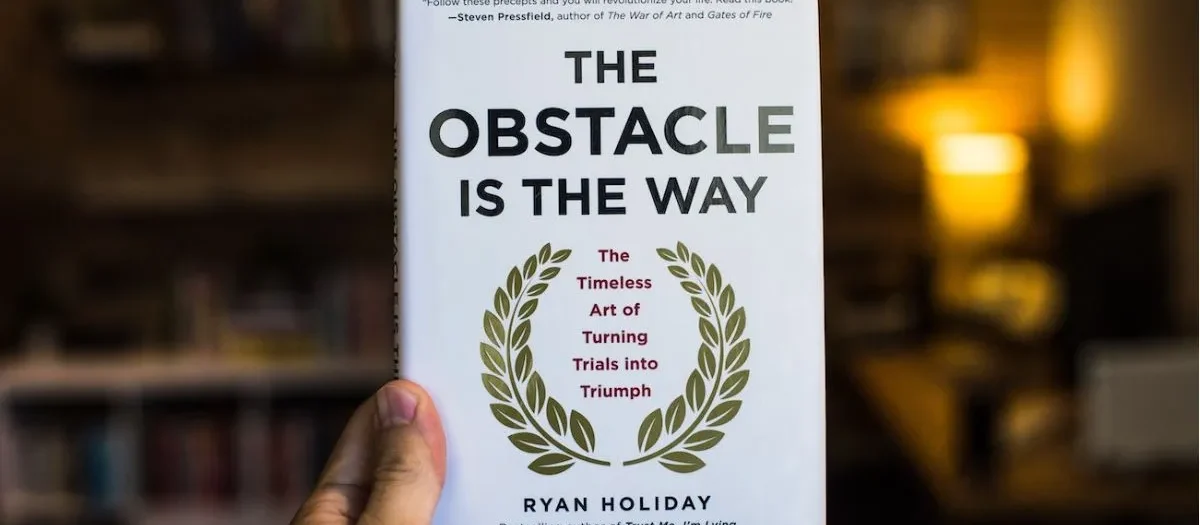
Holiday’s pragmatic Stoicism gives you a working framework for hard weeks. His historical examples are cherry-picked enough to make a careful reader squint.
The Core Idea
Something just went sideways. A deal collapsed, or news came back you weren’t ready for, or the job you were counting on quietly disappeared. Your first reaction is the one most people share: the chest tightens, and somewhere underneath, a quiet hope that ignoring this might be enough.
Ryan Holiday’s book is built on a different first reaction. The governing claim, drawn from a single line by Marcus Aurelius (“the impediment to action advances action; what stands in the way becomes the way”), is that the obstacle in front of you contains the path forward. What blocks the action becomes the action. What looks like ruin is, on closer inspection, working material.
Holiday treats this as an operating system. He breaks the response into three disciplines borrowed from the Stoics: perception (how you frame what’s happening), action (how you respond with measured effort), and will (how you absorb what you cannot change). Each discipline is illustrated with historical figures who, in his reading, applied it. Lincoln during the Civil War. Edison watching his lab burn at age 67. Demosthenes overcoming a speech impediment by practising with stones in his mouth. Theodore Roosevelt rebuilding his body after a sickly childhood.
The reason this matters tomorrow morning: most adversity in your life is small, repeated friction. Holiday’s framework gives you a way to work with it.
The Ideas That Actually Matter
Perception is the first lever. Most of what hurts about a setback is the story you wrap around it. Holiday argues that before you act, you control the frame, and that control is more available than people assume. The fact of the layoff is fixed. Whether you read it as catastrophe or as a forced opening is something you can choose. This is the Stoic discipline of perception, and it’s the cheapest, fastest tool in the book.
Action means small steps under pressure. Holiday spends a lot of time on persistence and measured effort. Edison tested thousands of filament materials before the lightbulb worked. Lincoln lost election after election before becoming president. The pattern Holiday wants you to absorb is that progress under adversity is mostly the same thing: showing up and trying the next thing. If you’ve read Atomic Habits or Deep Work, the underlying logic will feel familiar: systems and repetition outperform inspiration.
Will is the discipline of accepting what you cannot change. Once perception is steady and action has been taken, what’s left is endurance. Holiday introduces amor fati, the Stoic idea of loving your fate, including the parts you didn’t choose. This is the hardest section to apply and the easiest to misread. The discipline asks you to spend your energy on what’s still in front of you.
Premeditatio malorum, or imagining what could go wrong. A Stoic practice Holiday smuggles into modern productivity language. You walk through the failure modes of a project, a relationship, a plan, before they happen. The result, counterintuitively, is calmer execution. When the bad outcome arrives, you’ve already met it once in your head, and the meeting tends to be less violent.
The obstacle as material. This is the title and the load-bearing idea. Whatever you’ve been given, including the parts you’d return if you could, is the substance you have to work with. Lincoln’s depression. Roosevelt’s asthma. Demosthenes’s stutter. In Holiday’s reading, each used the limitation itself as the engine of their work. Whether the historical record fully supports this clean reading is a separate question (more on that below). But the practical move it points toward is real: work with what’s actually in your hands today.
Who This Book Is (and Isn’t) For
This book speaks to people facing meaningful adversity who want a practical, secular framework for moving through it. Founders dealing with collapse. Athletes working through injury. Anyone in a job loss, a divorce, a diagnosis, a creative slump. Holiday’s prose is brisk, anecdote-heavy, and unembarrassed about being motivating. If you want a clear scaffolding for thinking about hardship, this delivers.
If you’ve read Marcus Aurelius’s Meditations directly, or Epictetus, or Seneca’s letters, you’ll find Holiday’s version compressed and lightly seasoned for a modern audience. He’s the popular translator of a tradition that’s been studied for centuries, which is a real service for new readers and a noticeable simplification for experienced ones. For deeper Stoic work, William Irvine’s A Guide to the Good Life or Pierre Hadot’s The Inner Citadel sit in different rooms of the same house.
There’s heavy overlap with Holiday’s later books, especially Ego Is the Enemy, Stillness Is the Key, and Discipline Is Destiny. Together they form a quartet built on similar Stoic raw material. If you’ve already read Essentialism, the emphasis on what you can control will feel adjacent. And if Indistractable helped you see distraction as an emotional regulation problem, Holiday gives you the older, philosophical version of the same insight.
One honest caveat: this is a thinking framework. Readers in genuine crisis need clinical support alongside it.
The Steer Your Mind Take
Holiday’s real contribution is accessibility. He took a 2,000-year-old practical philosophy and made it usable for a reader who has 90 minutes and an inbox to clear. The Marcus Aurelius quote at the centre of the book is genuinely powerful, and the three-discipline structure gives you somewhere to put a hard week when it arrives. His weakness sits inside his strength: Holiday writes mostly through curated historical anecdotes, and the people he picks all happen to confirm the thesis. The figures who applied the same Stoic temperament and still lost don’t make the book. Survivorship bias is baked in, and once you notice it, some of the certainty wobbles. Read this for the framework. The question worth carrying away is simpler: what could you build out of the obstacle in front of you right now?