
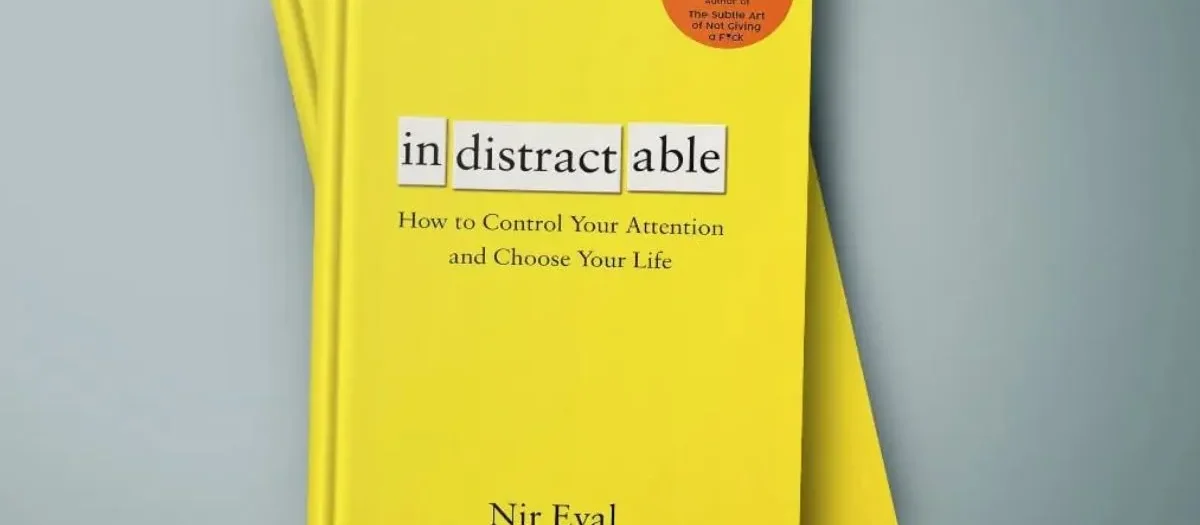
Nir Eyal wrote the playbook for making products addictive, then wrote the counter-playbook for resisting them. The tension between those two books is worth reading.
The Core Idea
You already won’t find it new. You sit down to write, to think, to do the thing that actually matters — and twenty minutes later you’re three tabs deep into something that doesn’t. Who is the one to blame? Your phone. The algorithm. Notifications…
The entire attention economy is conspiring against our focus. That we know – we can’t deny it. But it’s also comforting to just put the blame outside us.
Nir Eyal thinks that story is mostly wrong. The key insight of Indistractable is that distraction is not primarily a technology problem — it’s an emotional regulation problem.
We don’t reach for our phones because the notification pulled us in. We reach for them because we were already uncomfortable: bored, anxious, uncertain, restless. See the phone as the relief valve, not as the pressure source. Technology in this case is the proximate cause. The root cause is internal discomfort we haven’t learned to manage.
This reframe matters because it changes where you direct your effort.
If distraction is a tech problem, the fix is screen time limits and app blockers.
If it’s an emotional problem, the fix starts with understanding why you’re fleeing the task in front of you.
The author has built a four-part model around this:
Master your internal triggers,
Make time for traction,
Hack back external triggers, and
Prevent distraction with pacts.
The framework is simple — maybe too simple in places — but the internal triggers piece is where Indistractable does its most thinking and separates itself from the conversation about attention that tends to stop at blaming the platforms.
The Ideas That Actually Matter
Internal Triggers Are the Real Enemy — Every distraction has an emotional precursor. Before you picked up your phone, you felt something. Think of it for a second. Was it discomfort with a difficult paragraph, anxiety about an unanswered email, the low hum of boredom during a meeting?
Why do we seek that escape? It is when our psychological needs for autonomy, competence, and relatedness go unmet. The practical move is to notice the discomfort before you act on it. Name the feeling, sit with it for ten minutes, and see if the urge to distract yourself passes. It usually does. Test it and you will see it holds up.
Traction vs. Distraction — Eyal makes the following distinction: both words end in “action,” but traction pulls you toward what you want, while distraction pulls you away. The implication is that you can’t call something a distraction unless you’ve first defined what traction looks like. If you don’t plan your time, everything you do becomes reactive, and with that you won’t have a basis for knowing whether you’re on track or off it.
Try to schedule (timebox) every block of your day in advance. This is not for you to become rigid, as we all need some level of freedom to leave life to its flow. Timeboxing will help to create a baseline against which distraction becomes visible. If you’ve read Deep Work, this will be familiar to you. The difference is that Eyal applies the scheduling logic beyond work — to relationships, health, and personal time — arguing that if you don’t plan it, someone else’s priorities will fill it. Which certainly has truth in it – especially in our time when many are concerned about their own agendas.
Hack Back External Triggers — This is about auditing every notification, every open-plan office interruption, every group chat ping. For each external trigger, ask whether it’s serving you or serving someone else. If your phone buzzes 80 times a day and only four of those notifications relate to something you’ve chosen to prioritize, the other 76 are someone else’s agenda. The practical advice the author gives is not original, such as batching email, disabling non-essential notifications, using “do not disturb.” The author frames it as a design problem rather than a willpower problem, which makes it more likely you’ll actually follow through. He’s essentially applying the same environment design principles found in the habit literature, just pointed at subtraction instead of addition.
Pacts as Precommitment — When self-awareness and scheduling aren’t enough, the author proposes three types of pacts. Add some friction between you and the distraction. E.g., delete an app so reinstalling it takes effort. Attach a financial cost to getting distracted — burning money if you break your commitment. Is this even practical for many? Identity pacts shift how you see yourself: “I am indistractable” becomes a statement you live up to rather than a goal you chase. The identity pact echoes the identity-based habit framework from Atomic Habits, and it works for similar reasons. When your self-concept includes the behavior, the behavior requires less deliberation.
Who This Book Is (and Isn’t) For
If you’ve been treating distraction as a technology problem — installing app blockers, swearing off social media, trying digital detoxes that last a week — and the pattern keeps returning, Indistractable offers a different angle. It’s especially useful for people who already have some control over their schedules but keep sabotaging their own intentions. Knowledge workers, freelancers, remote workers, and parents navigating screen time with their children will find practical sections addressed directly to them.
There’s meaningful overlap with several books already covered in this series. If you’ve read Deep Work, you already have the argument for structured focus and environmental design. Indistractable adds the psychological layer — the why behind the distraction, not just the how of protecting against it. If you’ve read Essentialism, you’ll recognise the emphasis on defining what matters before you can identify what’s pulling you away from it. And the precommitment strategies draw directly from the same behavioural science literature that informs Tiny Habits. If you’ve read all three, roughly half of Indistractable will feel like familiar ground. The internal triggers framework is the half that’s new.
One caveat worth flagging: Eyal previously wrote Hooked, a manual for building habit-forming products. Critics have noted the tension in writing a book that teaches companies to capture attention and then writing a book that tells individuals to resist that capture. Eyal addresses this directly and argues the two aren’t contradictory — products should be designed ethically, and individuals should learn to manage their own responses. Whether you find that satisfying depends on how much responsibility you think should fall on the designer versus the user. It’s a fair debate, and to Eyal’s credit, he doesn’t dodge it.
The Steer Your Mind Take
Indistractable earns its place by locating the distraction problem where most people don’t think to look: inside. The internal triggers framework is a useful lens, and the four-part model gives you enough structure to act on it without overcomplicating things. That said, about a third of the book is workplace and parenting advice that reads more like extended appendices than core argument, and Eyal’s tone occasionally drifts toward the self-help optimism that the substance of the book doesn’t require. The strongest version of Indistractable is probably a long essay rather than a full book. But the central claim — that you are more complicit in your own distraction than you’d like to admit — is the kind of uncomfortable truth that, once you see it, reshapes how you spend tomorrow morning.