
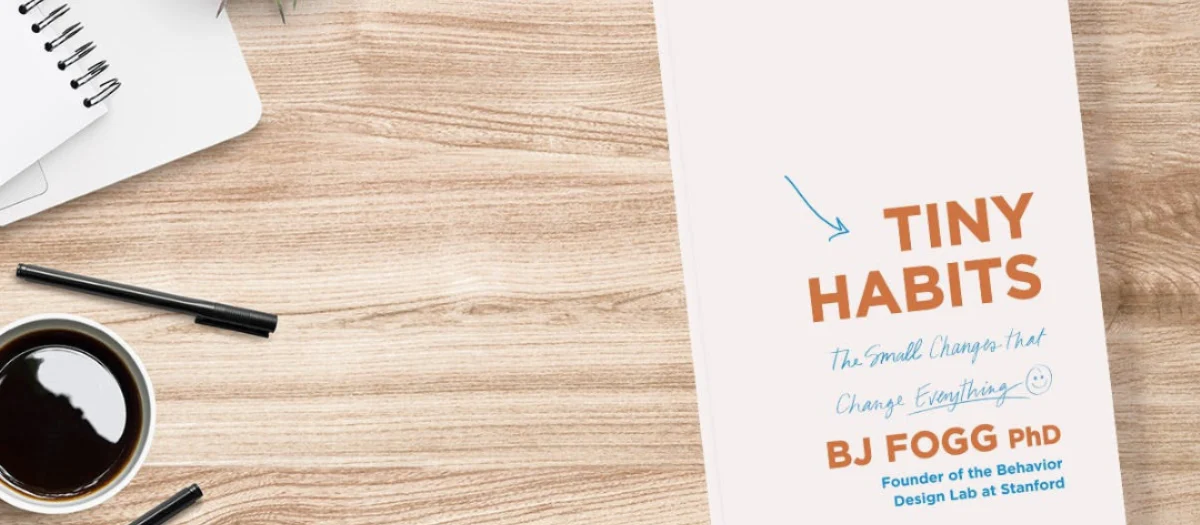
BJ Fogg’s Tiny Habits makes a compelling case that behavior change fails not because we lack willpower, but because we’ve been designing it wrong from the start. It’s a strong self-help book written by the researcher who originated some of the ideas.
The Core Idea
Easy to get. Simple. We’ve all been there.
You watch a motivational video, read an inspiring article, or have a moment of clarity at 2am – and suddenly you’re convinced this is the week everything changes.
It does sound familiar, right? Of course!
You’re going to meditate every morning. Journal every night. Hit the gym five days a week. You go hard for about nine days. Then life happens. The motivation disappears. And quietly, you stop.
And the worst part? You blame yourself.
To be fair to the author, let’s state the fact that BJ Fogg has spent over two decades at Stanford studying exactly why this keeps happening. And his answer is almost simple, something you probably already know the answer to: you didn’t fail because you lack discipline. You failed because you started too big, and you relied on the one thing that was guaranteed to let you down – motivation.
The entire framework of Tiny Habits comes down to Fogg’s Behavior Model: B=MAP. Behavior happens when Motivation, Ability, and a Prompt all show up at the same time. If any one of those three is missing, nothing happens.
And here’s the difficult truth: most of us have been doing this completely backwards. We try to change by cranking motivation up to the max – vision boards, accountability partners, dramatic Monday-morning commitments.
But we know it very well: motivation is volatile. It spikes and crashes like a bad stock. We do have a reliable lever instead. That is our ability. Make the behavior so small that we barely need any motivation to do it. One pushup. One sentence in a journal.
It sounds ridiculous. I know. But that’s the point. The idea is not trying to get fit from one pushup. By doing that, you’re building a neural pathway. And every time you do it and feel good about it, that pathway gets stronger.
The Ideas That Actually Matter
The B=MAP Formula — This is the engine beneath everything in the book. Behavior only happens when motivation, ability, and a prompt all show up together. And most failed habit attempts suffer from the same problem: high motivation paired with low ability and no reliable prompt.
It is not about pushing harder which we usually do. Just lower the bar on ability until you do it almost automatically, then attach it to a prompt you already encounter every day.
If you’ve read Atomic Habits, you’ll recognize the same DNA here. James Clear’s Four Laws are essentially a more accessible repackaging of Fogg’s original framework.
Anchor-Behavior-Celebration (The Tiny Habits Recipe) — This is the most immediately useful tool in the book. And it’s dead simple.
The format: “After I [existing routine], I will [tiny new behavior].”
After I pour my morning coffee, I will open my notebook. After I sit down at my desk, I will write one sentence. The existing routine is your anchor – it’s the prompt, already built into your day. The new behavior is tiny enough that it requires almost no motivation.
And then you celebrate. Which brings us to the next idea.
Celebration as the Mechanism, Not the Reward — This is where Fogg really separates himself from the rest of the habit literature. And it’s the idea with the most scientific weight behind it.
According to Fogg’s research at Stanford, habit formation isn’t primarily about repetition – it’s about emotion. When we do a behavior and immediately feel something positive, our brain encodes that behavior more deeply. Fogg calls this “Shine” – a deliberate, brief burst of positive feeling right after completing the tiny habit. A fist pump. A quiet “nice.”
Again, it feels silly. But it works. Because you’re hacking the same reinforcement loop that makes doomscrolling so addictive. Except you’re pointing it at something that actually serves you.
Motivation Waves — Fogg doesn’t demonize motivation. He just refuses to build a system on top of it. He describes motivation as a wave: sometimes it’s high, sometimes it’s low, and you have almost no control over which. We get that.
But this one is a really good takeaway: use your motivation surges to do hard, one-time things – restructure your environment, sign up for a class, buy the equipment. Don’t rely on them to sustain daily behaviors.
Use your motivated moments to build the architecture. The architecture will carry you when motivation disappears. This aligns with the environment design principles in both Deep Work and Atomic Habits.
Behavior Crafting — Fogg introduces the idea of matching habits to your specific life, not copying someone else’s routine. He uses a process called “behavior crafting” – brainstorming a wide range of possible behaviors that serve a goal, then filtering for the ones that are both effective and realistic for your particular situation.
And this is where Tiny Habits earns our like. Most habit books are nothing but a universal playbook. Fogg gives you a methodology to build your own. That’s a fundamentally different approach, and for a lot of people, it’s the one that actually sticks.
Who This Book Is (and Isn’t) For
Fogg’s approach is built for people who are tired of relying on motivation and want a system that works on the days when motivation doesn’t show up.
If you’ve already read Atomic Habits, there’s a lot of shared ground. Of course, Clear openly credits Fogg as an influence, and concepts like habit stacking and starting small are direct descendants of Fogg’s recipe format. But Clear is a better writer and storyteller. Fogg, on the other hand, is the researcher who built the underlying framework. Where Atomic Habits gives you a polished system, Tiny Habits gives you the lab notes.
That’s more rigorous, but less immediately engaging. Fogg’s writing can feel repetitive in places, and the personal anecdotes sometimes slow the pace. If you want depth over polish, this is your book. If you want a faster, cleaner read – you’ve probably already got the right one on your shelf.
The Steer Your Mind Take
Tiny Habits is a methodologically grounded book in the popular habit space.
You will find most authors in this genre are mere synthesizers – journalists or bloggers packaging research into digestible frameworks. Fogg is one of the sources. The B=MAP model, the emphasis on emotion over repetition, the recipe format – these aren’t borrowed ideas. That gives the book a credibility that’s not so easy to match.
The book is probably a little longer than it needs to be. And the relentless positivity of Fogg’s tone can feel like a TED talk that won’t end.
But the core method is sound, practical, and genuinely different from the willpower-first approach most people default to. If you take one thing from this book, let it be this: stop trying to motivate yourself into change and start designing change so small it doesn’t need motivation at all.