
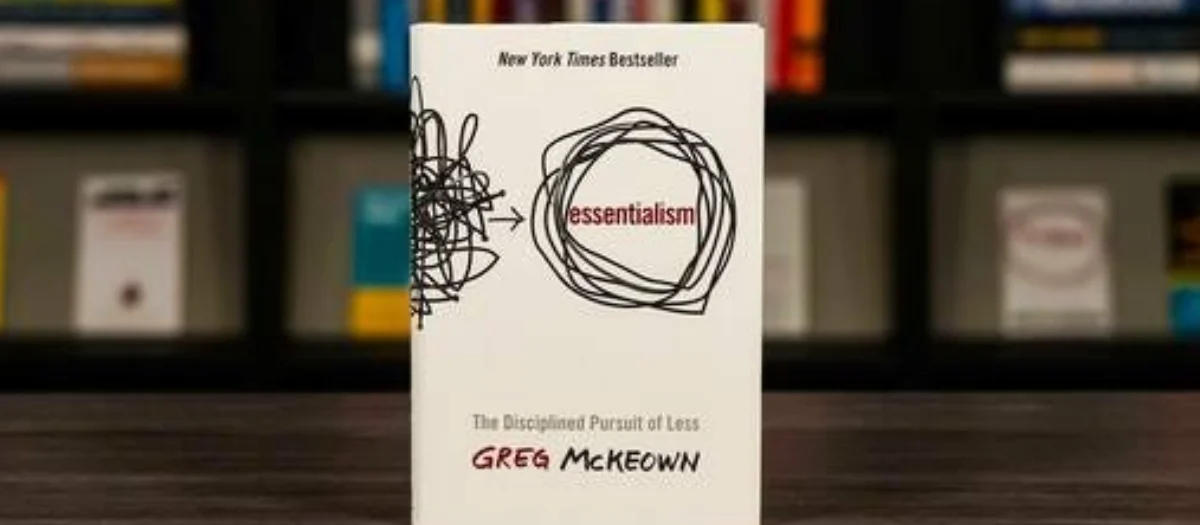
Greg McKeown’s Essentialism is the sharpest argument you’ll read for doing less — and the uncomfortable mirror that shows you why you haven’t started.
The Core Idea
Think about the last time someone asked you to take on something new. A project. A committee. A favour that would only take “a few minutes.” You said yes. Not because it was important, but because saying no felt harder than saying yes. Now multiply that by every week of your professional life. That’s the trap Greg McKeown’s Essentialism is designed to break.
The governing insight is deceptively simple: almost everything is noise. The vast majority of opportunities, requests, and activities that fill your days contribute little to nothing of real value. The essentialist response isn’t to find ways to fit more in — it’s to get ruthlessly selective about what gets your time in the first place. McKeown frames this as a shift from asking “How can I fit it all in?” to asking “What is the one thing that would make the highest contribution right now?” That second question is easy to understand and brutally difficult to live by, because it demands you disappoint people, abandon sunk costs, and accept that the world is engineered to scatter your attention.
This is not a time management book. Time management assumes everything on your list deserves to be there and tries to help you execute faster. Essentialism challenges the list itself. McKeown structures the book around three movements — explore, eliminate, execute — but the real engine is the middle one. Most of us are decent at exploring options and executing tasks. Where we fail, consistently, is in eliminating the things that don’t belong. We add. We accumulate. We say “just one more thing” until one more thing becomes the entire day.
The shift McKeown is after is not efficiency — it’s clarity. And once you frame it that way, the book stops being about productivity and starts being about how you choose to spend your life.
The Ideas That Actually Matter
The 90 Percent Rule — When evaluating an opportunity, score it on a scale of 0 to 100. If it’s below 90, treat it as a zero. This single heuristic cuts through the paralysis of “good enough” options and forces genuine selectivity. We all know the feeling of agreeing to something that’s a 7 out of 10 — interesting enough to justify, not important enough to deserve your best energy. McKeown’s point is that those 7s are exactly what keep you from the 10s. Apply this to your next meeting invite, project request, or social obligation and watch how quickly your calendar clears.
The Paradox of Success — Success creates options. Options create demands. Demands dilute focus. Diluted focus undermines the thing that made you successful in the first place. McKeown calls this the undisciplined pursuit of more, and it’s the most honest explanation we’ve seen for why talented people plateau. Jim Collins made a similar observation about companies — the same pattern applies to careers. The very moment you earn the right to be selective is the moment everyone else starts selecting your time for you.
Essential Intent — Most mission statements and goals are too vague to drive real decisions. McKeown argues for what he calls essential intent: a single, concrete, inspiring statement that is both meaningful and measurable. The test is whether it helps you say no. If your stated goal doesn’t give you clear grounds to decline a specific request, it’s too abstract to be useful. This is the same principle behind Cal Newport’s argument for structured focus — vague intentions don’t survive contact with a crowded inbox.
The Graceful No — Saying no is a skill, not a personality trait. McKeown dedicates significant space to the mechanics of declining — separating the decision from the relationship, offering a clear no with a partial yes, and recognising that a slow yes is worse than a fast no. If you’ve ever stalled on an email because you didn’t want to disappoint someone, only to end up half-committed to something you resent, this section alone justifies the book. The deeper insight here is that people respect a clear no far more than a reluctant, half-hearted yes — even if it doesn’t feel that way in the moment.
Uncommit — The sunk cost fallacy doesn’t just apply to investments and bad movies. It shapes how we manage our calendars, our projects, and our relationships. McKeown urges what he calls the reverse pilot: quietly remove something — a recurring meeting, a report, a process — and see if anyone notices. More often than not, nobody does. The things we cling to out of habit or guilt are frequently invisible to everyone but us.
Who This Book Is (and Isn’t) For
If you’re a high performer who has gradually said yes to so many things that you’ve lost track of what actually matters, this book was written for you. It’s especially useful for managers, founders, and knowledge workers who feel the pull of other people’s priorities more than their own. McKeown spent years advising leaders at companies like Apple and Google on this exact problem, and it shows — the examples skew corporate, but the principles translate to anyone with more demands than hours.
If you’ve already read Atomic Habits, you’ll recognise the emphasis on systems over willpower, though McKeown operates upstream — he’s less interested in how you build habits and more interested in whether you should be building them at all. There’s also meaningful overlap with Deep Work: both books argue that subtraction is more powerful than addition. Where Newport focuses on protecting your attention hour by hour, McKeown zooms out to the level of your commitments, goals, and identity. Read both and you’ve covered the problem from two complementary angles.
One honest caveat: if you’re early in your career and still figuring out what you’re good at, this book might be premature. Essentialism works best when you have enough experience to know which opportunities genuinely matter — and enough standing to decline the ones that don’t. If you’re still in exploration mode, absorb the philosophy but hold off on the ruthless elimination.
The Steer Your Mind Take
Essentialism earns its place because it asks a question most productivity books avoid: not “how do I get more done?” but “should I be doing this at all?” That reframe is genuinely valuable, and McKeown delivers it with enough research and real-world grounding to hold up under scrutiny. That said, the book could be tighter — some sections repeat the core thesis with different anecdotes rather than deepening it, and the tone occasionally drifts toward motivational rather than analytical. But the central discipline — to pursue less, but better — is one of those ideas that sounds simple until you try to live it. If you finish this book and change nothing about how you evaluate the next request for your time, you’ve missed the point entirely. And if you change even one thing, you’ll wonder why you waited.