
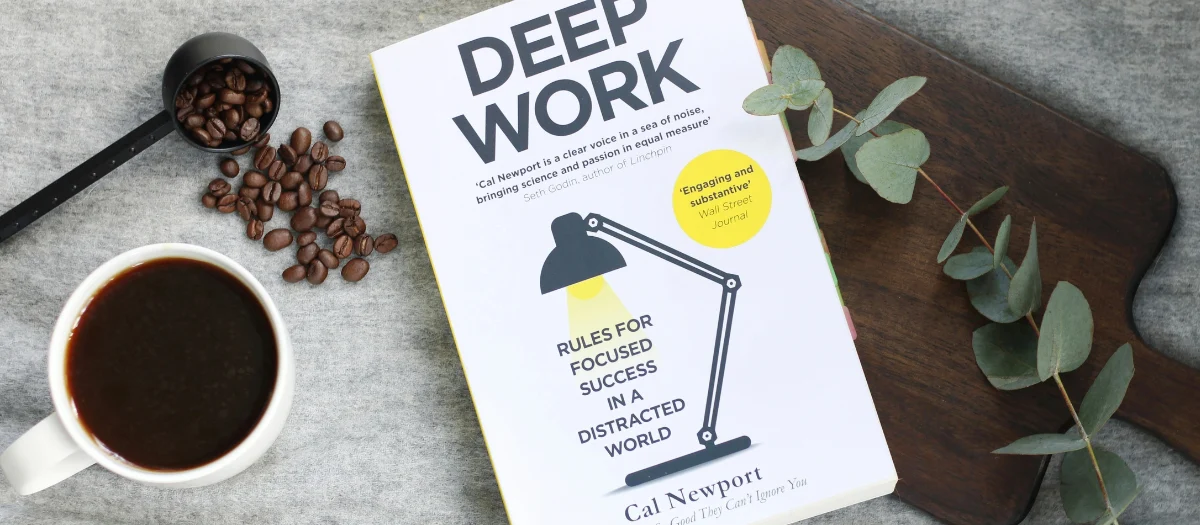
It would not be an exaggeration to say that Deep Work is one of the most practical arguments against distraction you’ll find — and the rare productivity book that’s actually about doing less, not more.
The Core Idea
Let’s pause for a sec. Can you think of a recent moment where you were engaged in deep work? What we mean by deep work is focused, uninterrupted, cognitively demanding work. You might (self-)critique and realize that it is increasingly becoming rare, while you know it is so valuable.
On one hand, we see that the economy increasingly rewards people who can produce things that are hard to replicate. On the other hand, producing those things requires sustained concentration.
Yet, speed matters even more. And it is undeniable that most knowledge workers today spend their days bouncing between email, Slack, and meetings, performing what the author calls shallow work. These are logistical, low-value tasks that feel productive but generate almost nothing of lasting worth.
The punchline of the book isn’t just that focus is good. It’s that distraction has a cost most people never calculate.
Every time you glance at your inbox mid-sentence, you pay an attention tax that lingers far longer than the interruption itself. While we know this is the fact for most of us, what is the solution? Trying harder not to get distracted?
In fact, this is where the author argues that the entire structure of most people’s work days is designed against depth. And that the fix isn’t willpower, it’s architecture.
This is where we see Deep Work land differently from most productivity advice. It doesn’t hand you a new app or a morning routine. It asks a harder question: are you willing to restructure your professional life around the thing that actually produces results?
The Ideas That Actually Matter
Attention Residue — When you switch from Task A to Task B, part of your mind stays stuck on Task A. This is known as attention residue, and the author uses it to dismantle the myth of effective multitasking. Every time you do a quick check of your email between writing sessions, remember it has a cost. It fragments your cognitive capacity for the next 10–20 minutes. Every similar interruption makes your deep work shallower, even after you return to it.
The Craftsman Approach to Tool Selection — Most people adopt new tools — social media, productivity apps, communication platforms — because they offer any possible benefit or just because they are cool to use. The author argues you should flip that logic. We can’t agree more. We should in fact adopt a tool only if its positive impact on our core work substantially outweighs the negative. This sounds obvious until you apply it honestly. That Twitter account you keep for “networking” — does the actual return justify the attention it drains? For most people, the answer is no.
Ritualize, Don’t Motivate — Waiting for inspiration or motivation to do deep work is a losing strategy. How do you think prolific creators and thinkers became so prolific? They built structured, rigid routines around their most important work. The ritual removes the decision. You don’t ask yourself whether you feel like writing at 6 a.m. You just write at 6 a.m. because that’s what the schedule says. The secret here is: the less you rely on feeling ready, the more you actually produce. Sounds familiar?
Embrace Boredom — If you reach for your phone every time you’re standing in a queue or sitting idle, you’re training your brain to need constant stimulation. The ability to tolerate boredom is a prerequisite for deep focus. You can’t spend all day feeding your mind distraction and then expect it to lock in for four hours of concentrated work. The more you stop filling your quiet moments with noise, the more you train your capacity for focus.
The 4 Disciplines of Execution — Borrowed from business strategy and adapted for individual deep work: focus on the wildly important, act on lead measures (hours spent in deep work, not outputs), keep a compelling scoreboard, and create a cadence of accountability. This framework turns deep work from an abstract ideal into a trackable practice. The author’s own habit of logging deep work hours on a physical tally is simple, almost laughably low-tech — and that’s exactly why it works.
Who This Book Is (and Isn’t) For
If you’re a knowledge worker who ends most days feeling busy but not productive — emails answered, meetings attended, yet nothing meaningful created — this book was written for you. It’s especially sharp for writers, programmers, academics, and anyone whose output depends on sustained thinking. The author gives you both the argument and the framework to restructure your days around what matters.
If you’ve already read Atomic Habits, you’ll recognize the emphasis on systems and environment design, but this one operates in a different lane. The book is less concerned with habit formation broadly and more focused on protecting and deepening your cognitive output specifically. There’s overlap in philosophy but almost none in practical advice.
That said, if you’re someone whose work is primarily physical, social, or reactive by nature — a nurse, a retail manager, a first responder — the prescriptions here will feel disconnected from your reality. The author writes for people who have some control over their schedules. If that’s not you, the principles still hold, but the applications won’t map cleanly.
The Steer Your Mind Take
Deep Work earns its place because it does something most productivity books avoid: it tells you what to stop doing. It does not sell you another fancy framework to layer on top of your cluttered day, but a genuine argument for subtraction.
Of course, as with every book, this one also has its limits. When you read it, you may find it dismissive of roles that genuinely require constant availability. The examples in the book skew heavily toward academia, and frankly, about a third of the book is repetitive case studies and philosophical detours that most readers will skim.
The core thesis — focus is rare, valuable, and trainable — could land in a sharp long-form essay. What earns the book-length treatment is the practical scaffolding: the scheduling philosophies, the 4DX adaptation, the shutdown ritual. Strip those out, and you have a compelling blog post. Leave them in, and you have a book that justifies itself.
Still, the central argument that your ability to focus deeply is the skill that will define your professional value is hard to argue with. Regardless of whether you read the book or not, let us self-critique and be vigilant to know when we are producing work that matters instead of just staying busy.