
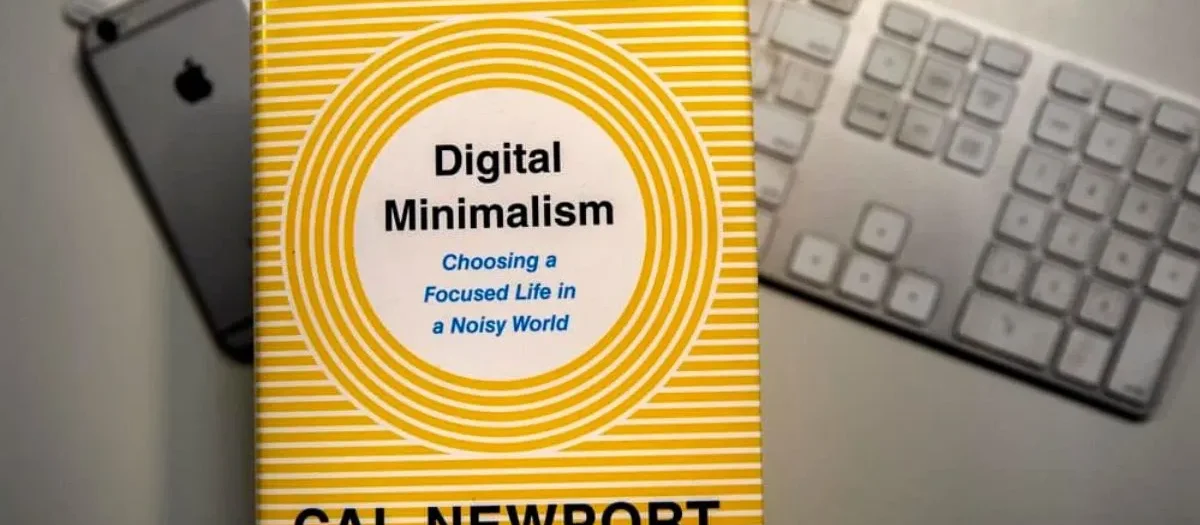
Minimalism is something we hear a lot these days, given the crisis we’re in, especially in the context of how capitalist corporations want to shape you and me. Adding a digital angle to it certainly grabs attention, so the title sounds intriguing.
The gist of the book is simple. We use too many apps, services, and screens, mostly without choosing to, and the cost shows up in our attention, our solitude, and our ability to enjoy time off the screen. Newport’s argument is narrower than “technology is bad.” He targets the default way we use it, and treats the tools themselves as mostly neutral.
That framing is the first thing I’d keep.
The one idea that earned its place
Newport’s definition of digital minimalism is the part of the book worth memorizing: a philosophy where you focus online time on a small number of carefully chosen activities that support things you actually value, and you happily miss out on the rest.
The useful word is “happily.” Without it, the philosophy reduces to another diet, white-knuckling through missed things until the willpower runs out. The cut only sticks when it feels like an obvious choice.
Newport organizes it around three principles:
- Clutter is costly. Many small uses of a tool add up to a large total cost.
- Optimization matters. Even a useful app can be used in a suboptimal way.
- Intentionality is satisfying in itself. The act of choosing how you use technology gives more value than the technology does.
These aren’t original observations, but together they form a usable test. Before opening an app, you can ask: does this serve something I value, and is this the best way to get that value? If both answers aren’t yes, you’re in clutter territory.
Solitude deprivation is the sharpest concept
The chapter on solitude is where the book stops being a productivity guide and becomes more interesting.
Newport defines solitude not as physical isolation, but as a subjective state where your mind is free from input from other minds. By that definition, you can be alone in a room and still not be in solitude. Headphones in, podcast on, scrolling, replying: that’s just being physically by yourself.
He calls the modern shortage of this state “solitude deprivation.” I find the term useful because it names something I had noticed but couldn’t articulate. The discomfort of being alone with my own thoughts had become unfamiliar. Not because I was busy. Because every gap was filled.
This is the idea I’d keep even if the rest of the book disappeared. It changes what you do with small waiting moments, and those moments add up to a lot.
The 30-day declutter as a forcing function
Newport’s practical proposal is to take a 30-day break from all optional digital tools, then reintroduce only the ones that pass the value test. Gradual reduction, he argues, doesn’t work because the pull of these tools is too strong to negotiate with on a daily basis.
I think this is right, with one caveat. The 30 days are useful as a reset, not as a permanent state. The real value is the gap of unfamiliarity that lets you notice what you actually missed and what you only thought you’d miss.
In my experience, those two categories are smaller than expected, and the second one is much larger than the first.
What I’m less convinced by
A few parts of the book felt thinner.
The high-quality leisure section pushes specific activities: woodworking, physical craft, analog hobbies. The underlying point is fair: passive consumption fills time without filling life, and active leisure competes for the same hours that scrolling tends to occupy. But the prescriptions feel narrow. Not everyone needs a workbench. The principle survives without the props.
The “attention resistance” chapter overlaps a lot with general productivity advice (delete social media from your phone, schedule low-quality leisure, batch your communications). Useful, but not new, and not the strongest part of the book.
The historical examples (Thoreau, Lincoln’s cottage, Arnold Bennett) sometimes do real work and sometimes feel like padding. Newport is at his best when he reasons from a mechanism, weaker when he reaches for a Romantic-era anecdote to give an idea more weight than it needs.
And there is repetition. The core argument gets restated in several wrappers. If you’re reading carefully, the book could be a long essay.
Where the ideas actually apply
For me, the real test of a book like this is whether anything in it changes a decision I make tomorrow.
Three things did:
- The intentionality test (value + best way) as a filter before opening an app, not after.
- Treating small moments of waiting as opportunities for solitude rather than gaps to fill.
- Designing a few high-quality off-screen activities so that the phone has actual competition, not just absence.
The first one matters most. Most digital habits don’t survive a clear answer to “what am I trying to get from this.” Most also don’t survive being asked twice.
Would I recommend it?
Yes, but selectively. If you’ve already read a lot about attention, focus, and the design of persuasive apps, the first half will feel familiar. The solitude chapter is the part I’d point someone to even if they read nothing else.
The book helps if you’re trying to think more clearly about why your default relationship with screens feels off, and you want a vocabulary for it. It helps less if you want a step-by-step plan, because the steps are the easy part. The harder part is the philosophy underneath, and Newport spends more time on the steps than the philosophy deserves.
If I had to keep one sentence from the book, it would be this: the goal is a clearer answer to what the screen is for.